Page & Layout Designer 11
Designer Pro+
3D Maker 7
Xara History
The early years
For the first 12 years we didn't develop software for the early IBM PC, simply because it was a lousy architecture, lousy processor and ran bad software (in our opinion at the time). It was successful for one reason only - the letters IBM. The Apple II computer was much more up our street, but was too expensive in the UK, and didn't sell enough. Remember back in those days there was no Internet and software had to be packaged and distributed the traditional way and so we couldn't consider a computer that didn't have any significant UK market.
So the computers we developed for - the BBC Micro and later the Acorn 32-bit RISC based machines - were much more Apple like in many ways.
ROMs
Xara (then called Computer Concepts) grew to become the largest developer for the Acorn computer - first the BBC Micro and then the Acorn Risc based computers. The second time around (Archimedes) we had to start again from scratch, as we'd spent a year or two developing Atari ST software.
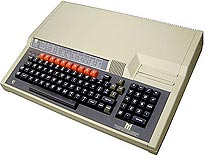
The Atari ST
We developed only a few packages for the Atari ST. The main one was Fast BASIC, a BBC-Basic like basic interpreter / compiler. BBC Basic was widely regarded as one of the best Basic dialects around - clean and modular. It included an inline assembler, which was hugely important for us because most of our programs were written in assembly language. The version we did for the Atari ST came on a ROM cartridge that you plugged in the side.
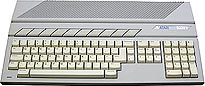
Archimedes
So once Acorn announced their first computer, it was off Atari, and back to developing Acorn software. That computer was simply the most advanced, from a hardware and software point of view, and we had to work on it.
We created a wide range of products for the Acorn Risc computers, including hardware products such as the LaserDirect, which was the world's first sub £1000 600-dpi laser printer. In 1990 we also developed our own Postscript clone (ShowPage) which was the beginning of a line of products taking us to Xara Designer Pro today.
But despite having world beating technology, poor management doomed Acorn. We could see this coming from the start and knew we would have to switch platform in order to survive.
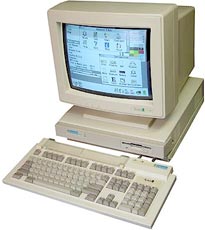
Acorn Dies - ARM lives!
Then the mobile evolution happened. Smart phones and tablets would simply not be possible without ultra-efficient low-power processors - and the Acorn ARM chip was the chip that made it all possible.
It would have been insane to imagine at the time that the ARM chip that we started programming in 1985 was to change the world, with more than 50 billion ARM processors now shipped. You've probably got half a dozen ARM processors in your pocket right now!
Here's some stats to blow your minds: The Archimedes computer, with the first ARM processor, ran at 8MHz, had 500Kbytes (half a megabyte) of RAM, and no hard disc. When they introduced the first hard disc, it was 20Mbytes. This was one of the most powerful desktop computers available.
Now, the phone in your pocket has multiple ARM processors (sometimes up to 8 of them), that run at 1000 MHz or more, has 2000 Megabytes of RAM and often 60,000 Megabytes of storage space. It's a thousand times faster, has a thousand times more RAM, and 3000 times more disc storage space, runs on batteries and fits in your pocket. 30 years of development.
Why not the Apple Mac
And Apple were in deep trouble. Steve Jobs had been kicked out of his company, and was developing the NeXT computer. Ask pretty much anyone at the time what the future of Apple was, and the answer was pretty unanimous: it had no future. No one could have anticipated that eventually Steve Jobs would get the company back and bring his NeXT software with him (which would eventually become the current Mac OSX ) and that he would transform Apple into a company worth more than Microsoft and Intel combined.
So maybe we made a mistake in not developing for the Mac from day one. Are we going do it now?? There's no Mac version imminent but we're not saying never!
Windows
So project Camelot was started in the early nineties, which was a ground-up rewrite of Artworks, but designed to be able to provide all the features of Impression our DTP package as well one day.
Xara was born
Where did the name come from? I saw a girl called Zara on TV and thought that was an unusual name. But decided to make it bit more unusual by putting an X in place of the Z, so a bit like Xerox. This had the benefit of being short, unusual, most importantly trademarkable around the world, and one where we could get the domain name. The downside is that we're always at the end of any alphabetical list!
Project Camelot
But after 5 years of them not selling and promoting our product as we would have liked we came to a mutual agreement to terminate the deal. So Xara regained all marketing rights to the product and started developing it again. That become Xara X, then Xara Xtreme and finally in two (classic and pro) versions Xara Photo & Graphic Designer and Designer Pro and the basis of Xara Web Designer.
MAGIX & International Expansion
Xara titles are now available under the MAGIX brand in German, French, Spanish, Dutch, Italian and Russian.
XARA CLOUD
We are often asked what we think the next platform will be. Is it apps and mobile? iOS or Android perhaps? Or Chromebooks? No, the next platform is the web, the cloud!
Take on the world
Charles Moir
CEO and founder
Xara Group Ltd

Product Timeline
-
Several small utilities for the Acorn Atom
Acorn Atom -
Space Invaders
Game
Acorn Atom -
Wordwise
Word Processor
BBC Micro -
Snake
Game
BBC Micro -
SpaceHawks
Game
BBC Micro -
Code Race
Game
BBC Micro -
Asteriod Belt
Game
BBC Micro -
Dissasembler
6502 programmer utility
BBC Micro -
Logo 2
Logo graphics language
BBC Micro -
Cube
Rubik's cube
BBC Micro -
Adventure
Game
BBC Micro -
Fruit Machine
Game
BBC Micro -
Sound Idea
BBC Micro -
Chess
Game
BBC Micro -
Reversi
Game
BBC Micro -
Android Attack
Game
BBC Micro -
Games Galore
Game
BBC Micro -
Swarm
Game
BBC Micro -
Draughts
Game
BBC Micro -
Beebcalc
Spreadsheet
BBC Micro -
Graphics ROM
Graphics utilities
BBC Micro -
Disc Doctor
Disc utility
BBC Micro -
Gremlin
Programmer utility
BBC Micro -
Sidewise Extension Board
Add extra ROMs
BBC Micro -
Caretaker
Utility
BBC Micro -
Wordwise Plus
Updated word processor with programming language
BBC Micro -
Printmaster
Printing utility
BBC Micro -
Communicator
Terminal emulator
BBC Micro -
Termi II
Terminal emulator
BBC Micro -
Speech System
Speech synthesiser
BBC Micro -
Acclerator
BBC Basic compiler
BBC Micro -
Inter-Sheet
Integrated Office suite
BBC Micro -
Inter-Chart
Integrated Office suite
BBC Micro -
Inter-Word
Integrated Office suite
BBC Micro -
Fast ASM
68000 Assembler and editor
Atari ST -
Fast Basic
BBC-like Basic interpreter / compiler
Atari ST -
Back Pack
A set of general utilities
Atari ST -
Calligrapher
DTP package - aborted
Atari ST -
Spellmaster
Spell checker
BBC Micro -
Inter-Word
Integrated Office suite
Archimedes -
Inter-Sheet
Integrated Office suite
Archimedes -
Inter-Chart
Integrated Office suite
Archimedes -
Wordwise Plus
Word processor
Archimedes -
ROM podule
Allow ROMs to be plugged into Archimedes
Archimedes -
Mega 3
Word, Sheet & Chart
Archimedes -
ARM Assembly Language
book
Archimedes -
Inter-Base
Integrated Office suite
BBC Micro -
Impression
DTP package
Archimedes -
Spellmaster Z88
Text editor with spell check as you type.
Sinclair Z88 -
DTP at a glance
Book
BBC Micro
-
Impression 2
Updated DTP package
Archimedes -
Impression Junior
As it suggests
Archimedes -
Equasor
Equation editor
Archimedes -
ShowPage
Postscript emulator
Archimedes -
LaserDirect
Direct drive 600dpi laser printer
Archimedes -
Scanlight
Scanner
Archimedes -
SpellMaster
Spell checker
Archimedes -
Fax Pack
Fax software and hardware
Archimedes -
Impression Bizz Supplement
supplement to Impression
Archimedes -
Compression
General ZIP like compression utility
Archimedes -
Impression Borders
Fancy borders for frames
Archimedes -
Font discs
Font packs
Archimedes -
ArtWorks
Vector graphics - direct ancestor of Xara Designer
Archimedes -
Colourcard
Graphics card
Archimedes -
TurboDrivers
Printer drivers
Archimedes -
Canon inkjet printers
Printer & printer drivers
Archimedes -
A3000 expansion box
Extra expansion card capacity
Archimedes -
Hawk V9
Video capture
Archimedes -
Chroma Genlock
Chrome locking video board
Archimedes -
Impression Style
Word processor style DTP
Archimedes -
Impression Publisher
Heavyweight DTP
Archimedes -
Audioworks
Sound editing utility
Archimedes -
Wordworks
Dictionary / Thesarus
Archimedes -
MacFS
Mac disc reading utility
Archimedes -
ClipArt CDs
clipart from Artworks contests
Archimedes -
Graphics Loaders
Import / export filters
Archimedes -
Eagle M2
Video capture board
Archimedes -
ScanLight Video
Video capture board
Archimedes -
MidiMax
Midi expansion card
Archimedes -
GreyHawk
Greyscale video capture
Archimedes -
Pioneer CD drives
CD Rom drive
Archimedes -
Impression Publisher Plus
Even more heavyweight DTP
Archimedes -
Formulix
Advanced formula / equation editor
Archimedes -
Lark card
Sound card
Archimedes -
TV Tuner
TV tuner card
Archimedes -
Movie Majic
Movie editing software
Archimedes -
Wacom ArtPads
Tablet and driver software
Archimedes -
Xara Studio
Vector graphics
Windows -
Eidoscope
Video editing software
Archimedes -
CorelXARA
Corel branded Xara Studio
Windows -
Xara Networks
Corporate ISP
All -
Various Artworks tools (Easox pressure, Arranger, Precision, later Hatch)
Archimedes -
Text Loaders & Savers
RTF & Word Perfect loaders/savers
Archimedes -
Webster
Cut down vector graphics
Windows -
Xara3D
3D text & animations
Windows -
Xara Webstyle
Template based web graphics
Windows
-
Xara X
New CorelXARA under our own brand
Windows -
Xara Online
Online Web Services
All -
Menu Maker
DHTML menus for websites
Windows -
ScreenMaker
3D screen saver maker
Windows -
Xara Xtreme LX
Open Source Xara Xtreme
Linux -
Xara Xtreme Pro
Pro version of Xara X
Windows -
MAGIX
Xara titles begin to appear in many different languages under the MAGIX brand
Windows -
Xara Web Designer
New web design title
Windows
-
Photo & Graphic Designer
Xtreme, renamed and updated
Windows -
Xara Designer Pro
Xtreme Pro, renamed and updated
Windows -
Web Designer Premium
Pro version of Web Designer
Windows -
Page & Layout Designer
New page layout & DTP title
Windows -
Xara Online Designer beta
Create & edit Xara documents online
All platforms -
Update Service
The introduction of our Update Service, which delivers updates to our Designer products throughout the year.
Windows -
Designer Titles
Release latest updates to Web Designer, Photo & Graphic Designer and Designer ProX.
Windows -
Xara Cloud
Commercial release of Online Designer as 'Xara Cloud'.
All platforms
Registered in England and Wales: Company registration number 3097032: Registered Office and Company HQ: Gaddesden Place, Hemel Hempstead, HP2 6EX: VAT registration number 814038749